08.06.21
| Downloadable


Heat treating is done to give a certain material specic mechanical properties. These outcomes— which depend on the base material being used, the processes used to obtain them, and the applications the material is destined for— allow manufacturers to work with raw materials uniquely suited to their purposes. Whether those properties wear resistance for a long service life, or the ability to resist cracking following impact, heat treating draws these desired characteristics out of the material for optimal results and performance.
If heat treating is a necessary step in your manufacturing process, this paper discusses some variables worth examining. Steel grade, alloy makeup, and intended end-use all have an effect on how and why heat treating is undertaken. What follows here is an overview of some of those different processes, how a material’s makeup affects heat treating decisions, and how application affects the process. It’s a purposefully and necessarily surface-level overview of what are extremely complex physical and chemical processes, but it should help to initiate non-experts into some of the key issues and concepts concerning heat treating. It should be considered a supplement, and not a stand-in, for the professional advice of a heat treating expert on the particular circumstances which will determine the direction of your heat treating project.
In the most general sense, heat treating consists of the following steps.: preheat, austenitizing, quench, and temper. The following graph represents the order of the steps and the relative temperatures under which they are conducted.
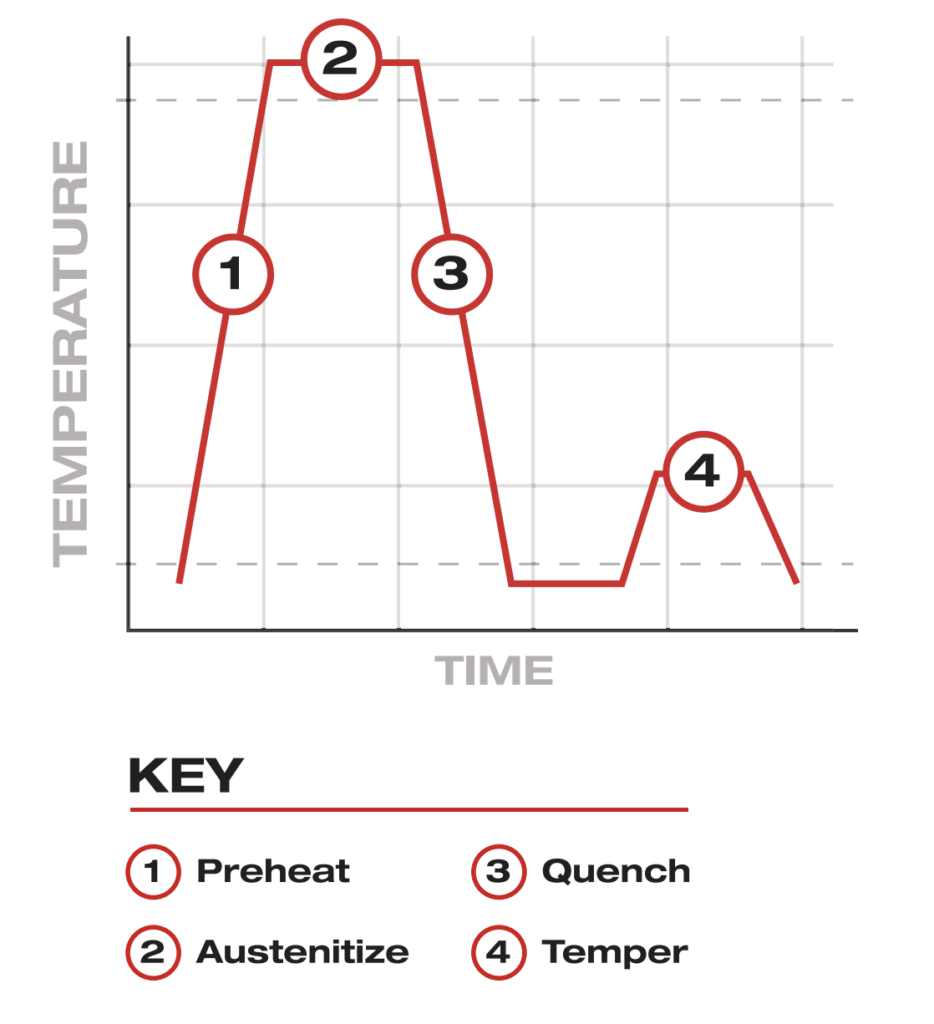
We’ll talk more about how each of these processes can be tweaked and specialized equipment can be tapped for slightly different effects, but for now it may be helpful to keep these general steps in mind while developing an understanding of heat treating as a whole.
But, why steel? What is it about the material that makes it amenable to heat treating and, subsequently, to manufacturing?
You may wonder why steel needs to be heat treated at all, or why steel often doesn’t leave the factory as a completely finished product. Why does it so often occur after the fact? As it turns out, the very qualities that make steel such an effective allaround raw material for manufacturing are some of the very same qualities that make heat treating necessary.
But first, a breakdown of what steel actually is.
So, what happens during heat treating that leads to such a change in properties? Because it’s important to understand the heat treating process as a whole, and the cooling process especially, a shallow dive into the physics and chemistry of the process is required here.
But bear with us here, because the simple juxtaposition of carbon and iron atoms is solely responsible for some of the most important physical properties targeted during heat treating.
Carbon atoms can’t normally squeeze in between the iron ones, but when temperatures exceed roughly 1,350 degrees Fahrenheit, the carbon atom fits and carbide dissolves. The steel temporarily becomes one substance.
Once these materials are cooled—in the process known as quenching— the carbon atoms remain trapped between the iron atoms. This keeps the steel a solid solution until the carbon atoms are once again forced out during tempering. The rate at which this cooling occurs will have a direct effect on what properties are preserved in the nished product. The different effects that can be achieved, through a combination of different heating and cooling techniques, explain why steel as an alloy and heat treating as a process are so valuable to the manufacturers who make the parts in our cars, buildings and critical infrastructure, among a huge variety of other applications.
As mentioned, heat treating is undergone to give a material certain properties that, for a variety of reasons, simply can’t be manufactured in the state desired for the nal product. The part may need to be softer for additional fabrication, or it may need to be tougher or more resistant to wear than the as-fabricated alloy. Or, a manufacturer may simply be trying to coax more desirable properties from less expensive materials. In this section we’ll briey discuss some of the techniques used to achieve these properties so that manufacturers can have confidence that their materials will perform the way they intend them to.
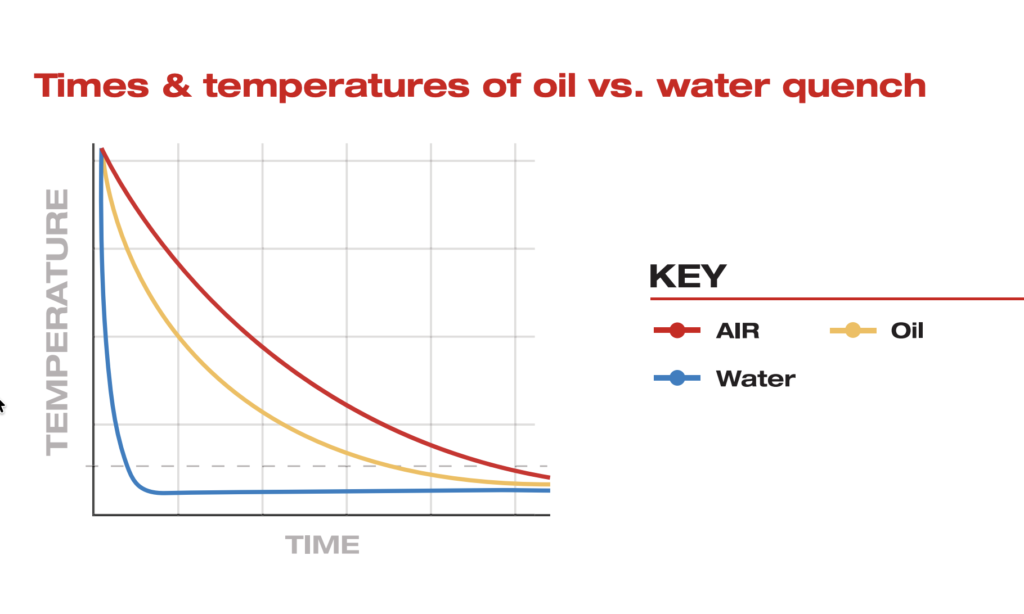
Quenching is one of the main ways in which a modifying process can yield desired results. The rate at which a material is cooled, controlled by modifying the medium used for the cooling, has a major effect on the depth of hardening the material undergoes.
In general, the faster the quench, the greater the depth of hardening.
The cooling rate will inuence how the carbon is forced out from in between the iron atoms. If cooling rate is extremely slow, say for the better part of a day, spherical carbides will form in the iron matrix. This means the material will have good formability and lower risk of cracking during fabrication.
Faster cooling rates, such as with an air cool, form smaller types of carbides that increase strength and reduce formability. Quench rates that are even faster yet, such as with liquid quenching, lead to the formation of martensite, which can dramatically increase strength and further reduce toughness of the material.
Deciding on quench rate involves trading off between desired properties in order to get a material that’s wellsuited to a customer’s business ends.
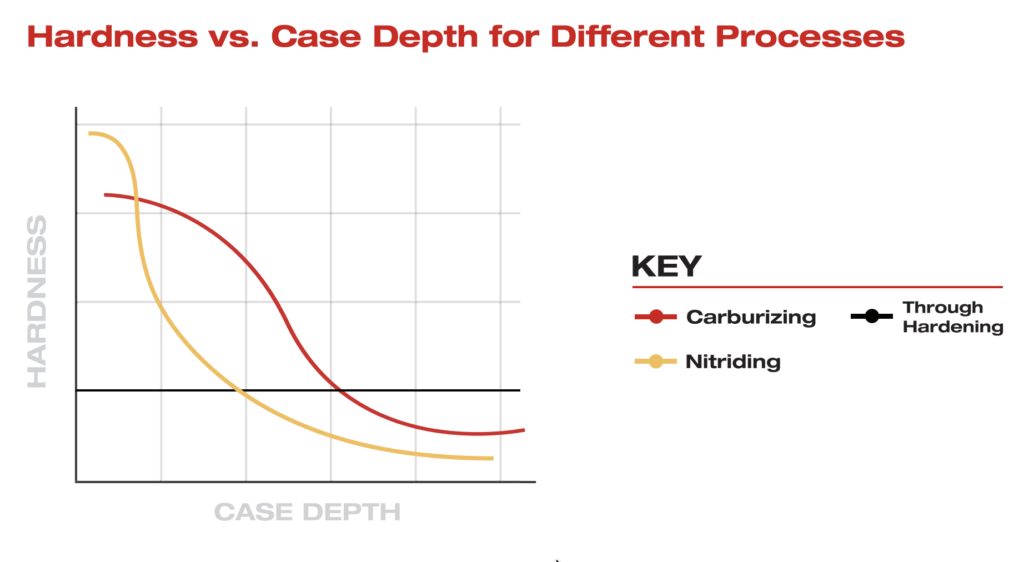
Case hardening is the infusion of carbon or carbon and nitrogen into steel to create a hard outer layer that preserves the material’s soft inner core. It’s an alternative for applications where stress may cause a material that’s been uniformly hardened throughout to crack during application. Case hardened materials preserve a comparatively soft inner core that’s able to give somewhat under force, while the harder outer core provides wear resistance and can stand up to repeated impact. This makes case hardening ideal for applications such as rearm components, camshafts and screws.
Ferritic nitrocarburizing, a specic method for case hardening, involves the diffusion of nitrogen and carbon into a material at a temperature that’s low enough to avoid many problems associated with higher temperatures, such as distortion. This process is ideal for many bearing, cast, forge, and tooling applications. Relatedly, neutral hardening is another case hardening technique which preserves a martensite structure for strong, wear-resistant material
Tempering is a process conducted later in the heat treating cycle and sometimes more than once. It is usually done to improve ductility, often at the cost of strength and usually only when parts are quenched extremely rapidly, with the objective of forming martensite, an extremely hard crystalline structure on the surface of the steel.
In summary, heat treating is simply the heating and cooling of materials in order to give materials certain specied properties. It’s only possible because one element of steel, carbon, wants to be present as a carbide (not mixed in with iron) at room temperature. How heat treating is conducted, and the outcomes it generates, should and will vary greatly with the alloy’s makeup, its intended application and the exact process it undergoes.
Thankfully, measurements are possible for testing the outcomes of heat treating procedures. This means that manufacturers, when they send out their materials to undergo heat treating, have recourse to objective assessments that will help them verify the quality of the work that’s been done.
The process of heat treating is full of rules and exceptions to those rules. While it’s possible to outline the general process in an introductory guide such as this one, the real work for manufacturers considering their heat treating options will happen when discussing their particular needs, circumstances, and materials with an experienced metallurgical professional.
Need help with your parts? Request a quote and we’ll connect you with a heat treating expert.
 English
  Español de México